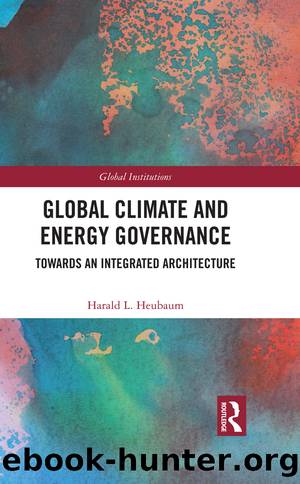
Global Energy and Climate Governance: Towards an Integrated Architecture by Harald Heubaum
Author:Harald Heubaum [Heubaum, Harald]
Language: eng
Format: epub
Tags: International Relations, Public Policy, City Planning & Urban Development, Science, Sociology, Global Warming & Climate Change, History & Theory, Ecology, Social Science, Political Science, Urban, Nature, General
ISBN: 9781315661339
Google: dfCazgEACAAJ
Publisher: Routledge
Published: 2021-12-15T09:36:45+00:00
A balancing act
Passage of the Kyoto Protocol at COP3 in 1997 brought climate change into sharper international focus. While fossil fuels received no direct mention in the Protocol, it was clear that their combustion lay at the heart of the climate change conundrum. The energy sector was not yet part of the solution, however, with fossil fuel consumption and associated GHG emissions continuing to grow largely unabated. The IEA Secretariatâs own World Energy Outlook (WEO) â the international bureaucracyâs annual flagship publication prepared and published under the direction of the Chief Economist â projected an increase in energy consumption of 65 percent and CO2 emissions by 70 percent until 2020 in a business-as-usual scenario, with 95 percent of the additional energy consumption coming from coal, oil, and gas.18 The IEA supported the UNFCCC process but occupied a more middling position on the treaty, focusing on an analysis of energy policy and emphasizing market-based mechanisms such as emissions trading spelled out in the Protocolâs flexibility mechanisms, rather than offering the Protocol its full-throated support. It also did not make a concerted push for renewable energy sources or energy efficiency that were at the time seen to play only a complementary role in any climate change mitigation strategy.19
In a 1998 publication entitled âBenign Energy?â, the IEA questioned the feasibility of a large-scale transition toward renewable energy sources. Renewables should be a factor, but their wide-scale application was held back by a number of environmental problems such as habitat loss from large hydropower projects and undesirable visual impacts of wind farms.20 The following year, the IEAâs Executive Director, Robert Priddle reiterated the publicationâs views in an opinion article published in the Bulletin of the International Atomic Energy Agency in which he questioned âthe glib assumption that renewables are all good for the environment and fossil fuels all bad.â21 This view remained as the IEA position for years to come. In a speech to COP7 in Marrakech in 2001, Priddle emphasized that the environmental impacts of energy use, including climate change, needed to be approached with a view to ensuring the security of energy supply, which was high on the international agenda following a global economic downturn and the 9/11 terror attacks. Renewables could contribute to achieving energy security âbut no fuel or technology can be excluded. Carbon-intensive energy forms may also become environmentally-benign through technologies such as carbon sequestration. Advances in nuclear technology could resolve both safety fears and the dilemma of waste disposal.â22 The Kyoto Protocol, meanwhile, only received a passing mention from the Executive Secretary in his address to a conference that was key to finalizing most of the Protocolâs operational details and moved parties toward ratification of the worldâs first climate treaty.
This more careful positioning may at least in part be explained by the US stance on the climate change mitigation more generally, and the Kyoto Protocol specifically. The IEA was created following a proposal by US Secretary of State Henry Kissinger who was driven by a desire to both
Download
This site does not store any files on its server. We only index and link to content provided by other sites. Please contact the content providers to delete copyright contents if any and email us, we'll remove relevant links or contents immediately.
Spell It Out by David Crystal(36108)
Life for Me Ain't Been No Crystal Stair by Susan Sheehan(35795)
Cecilia; Or, Memoirs of an Heiress — Volume 1 by Fanny Burney(32538)
Cecilia; Or, Memoirs of an Heiress — Volume 2 by Fanny Burney(31934)
Cecilia; Or, Memoirs of an Heiress — Volume 3 by Fanny Burney(31925)
The Great Music City by Andrea Baker(31911)
Professional Troublemaker by Luvvie Ajayi Jones(29644)
We're Going to Need More Wine by Gabrielle Union(19030)
The Secret History by Donna Tartt(19025)
Twilight of the Idols With the Antichrist and Ecce Homo by Friedrich Nietzsche(18617)
All the Missing Girls by Megan Miranda(15924)
Cat's cradle by Kurt Vonnegut(15324)
Pimp by Iceberg Slim(14476)
Bombshells: Glamour Girls of a Lifetime by Sullivan Steve(14046)
For the Love of Europe by Rick Steves(13860)
Talking to Strangers by Malcolm Gladwell(13340)
Norse Mythology by Gaiman Neil(13332)
Fifty Shades Freed by E L James(13228)
The Social Justice Warrior Handbook by Lisa De Pasquale(12182)
